May 11, 2026
at
11:55 am
EST
MIN READ
Why Is The Ethereum Foundation Unstaking $50M ETH?
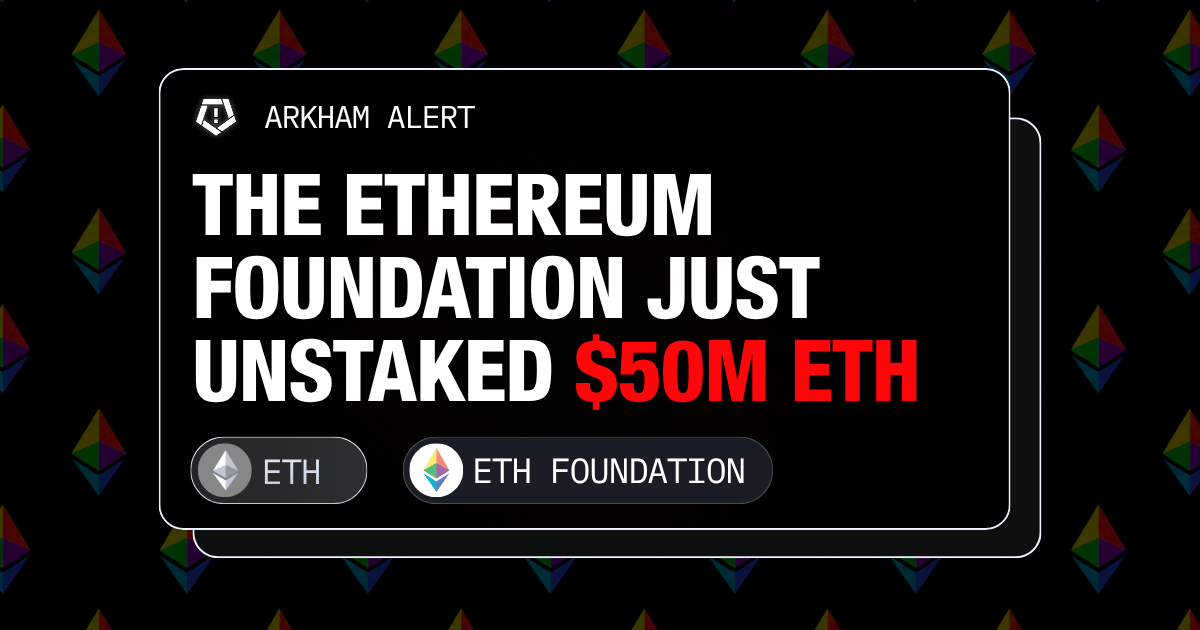
The Ethereum Foundation has just unstaked nearly $50M worth of ETH. The unstaking occurred across multiple different transactions, all worth $2.33M.
The total amount of ETH withdrawn was 21,270. It has been withdrawn from Lido, the third-party, decentralized liquid staking protocol.
You can interact directly with the unstaking transactions in the interactive window from Arkham Intel below:
This specific unstaking process involves depositing stETH - Lido’s wrapped liquid ETH token - into Lido’s unstaking contract. The stETH is then converted back into ETH and withdrawn. This process takes some time due to Lido’s withdrawal mechanics.
Why is the Ethereum Foundation Unstaking ETH?
1. Lost Faith in Third-Party Protocols After Recent Exploits
Security is extremely important for the organization that builds and maintains the base layer of the Ethereum network. The DeFi ecosystem has been rattled by massive exploits orchestrated by Lazarus Group - North Korea’s state-sponsored hacking entity. Hundreds of millions have been drained from major platforms - including the $290M KelpDAO exploit and the $285M Drift Protocol hack in April alone.
It may be that the EF simply believes the risk landscape for liquid staking protocols is too high. The string of infrastructure-level attacks may have led to the Foundation losing faith in the security guarantees of third-party protocols.
2. Need Funds for Development of the Network
Alternatively, the EF may just need funds to continue paying for development. The foundation functions as a non-profit dedicated to supporting the network's ecosystem, meaning they must occasionally reallocate portions of their treasury to cover operational expenses, grant programs, and protocol development.
The financial overhead required to fund developers, researchers, and exhaustive security audits continues to grow for the Ethereum network as it moves into the mainstream. This is not the first time the foundation has sold ETH to cover operational expenses.
The foundation has made strategic sales throughout its history, with notable sales in 2018, 2021 and 2024. At the end of April/beginning of May 2026, the EF sold 20K ETH to treasury company Bitmine in an OTC deal.

.png)






.png)











.png)




.jpg)









.png)

.png)



.png)



.png)


.png)
.png)


.png)
.png)








.png)
.png)
.png)
.png)




.png)






.png)