September 24, 2026
at
8:50 am
EST
MIN READ
How To Track Zcash Transactions
Zcash is a digital currency built on Bitcoin's foundations, but designed to fix what its creators saw as Bitcoin's biggest flaw: the fact that anyone can see everything. Like Bitcoin, it has a hard cap of 21 million tokens, cuts its block reward in half every four years, and runs on a Proof-of-Work consensus mechanism. Under the hood, it also shares Bitcoin's UTXO transaction model. In most cases, a Zcash transaction looks identical to a Bitcoin one. The difference is that some of them are designed to be completely invisible.
Privacy is one of the defining themes of the current crypto cycle. Regulatory pressure is intensifying globally, on-chain surveillance tools have become increasingly powerful, and a growing number of users, retail and institutional alike, are asking whether public blockchains expose too much information about its users and their trades. Against that backdrop, privacy coins have moved from a niche corner of the market to one of its most watched categories. Zcash was one of the standout performers of 2025 as a result.
History and Background
Zcash launched in October 2016, developed by the Electric Coin Company, a team founded by cryptographer Zooko Wilcox-O'Hearn alongside a team of experienced cryptography academics. The project traces its roots to a 2014 paper introducing the Zerocash protocol, produced by researchers from MIT, Johns Hopkins, and Tel Aviv University, which theorized a protocol allowing users to pay each other privately, and with throughput competitive with Bitcoin.
The zk-SNARK cryptography at Zcash's core predates crypto entirely, emerging from decades of theoretical computer science research. The Electric Coin Company made it practical enough to run on a live blockchain. A cryptographic setup ceremony was conducted in 2016 to generate the system's parameters, followed by a second ceremony called Sapling in 2018, which made shielded transactions efficient enough for everyday use.
Zcash is governed by two organisations: the Electric Coin Company, which handles protocol development, and the Zcash Foundation, an independent non-profit overseeing the broader ecosystem. A portion of newly mined ZEC funds both, ensuring continued development without reliance on external investment.
Zero-Knowledge Proofs
The technology that makes Zcash's privacy possible is called a zero-knowledge proof. Specifically, a variant known as a zk-SNARK (Zero-Knowledge Succinct Non-Interactive Argument of Knowledge).
The concept sounds abstract, but the idea is straightforward. A zero-knowledge proof lets one party prove to another that a statement is true without revealing any of the underlying information. In Zcash's case, the network can verify that a transaction is valid - the sender has the funds, and no coins are being created out of thin air - without ever revealing who sent what to whom.
This was a cryptographic breakthrough. Bitcoin's transparency is a feature for auditability, but it's a big problem for anyone who wants financial privacy. Zcash's developers took Bitcoin's codebase and layered zk-SNARKs on top of it to create an optional privacy shield.
Transaction Types
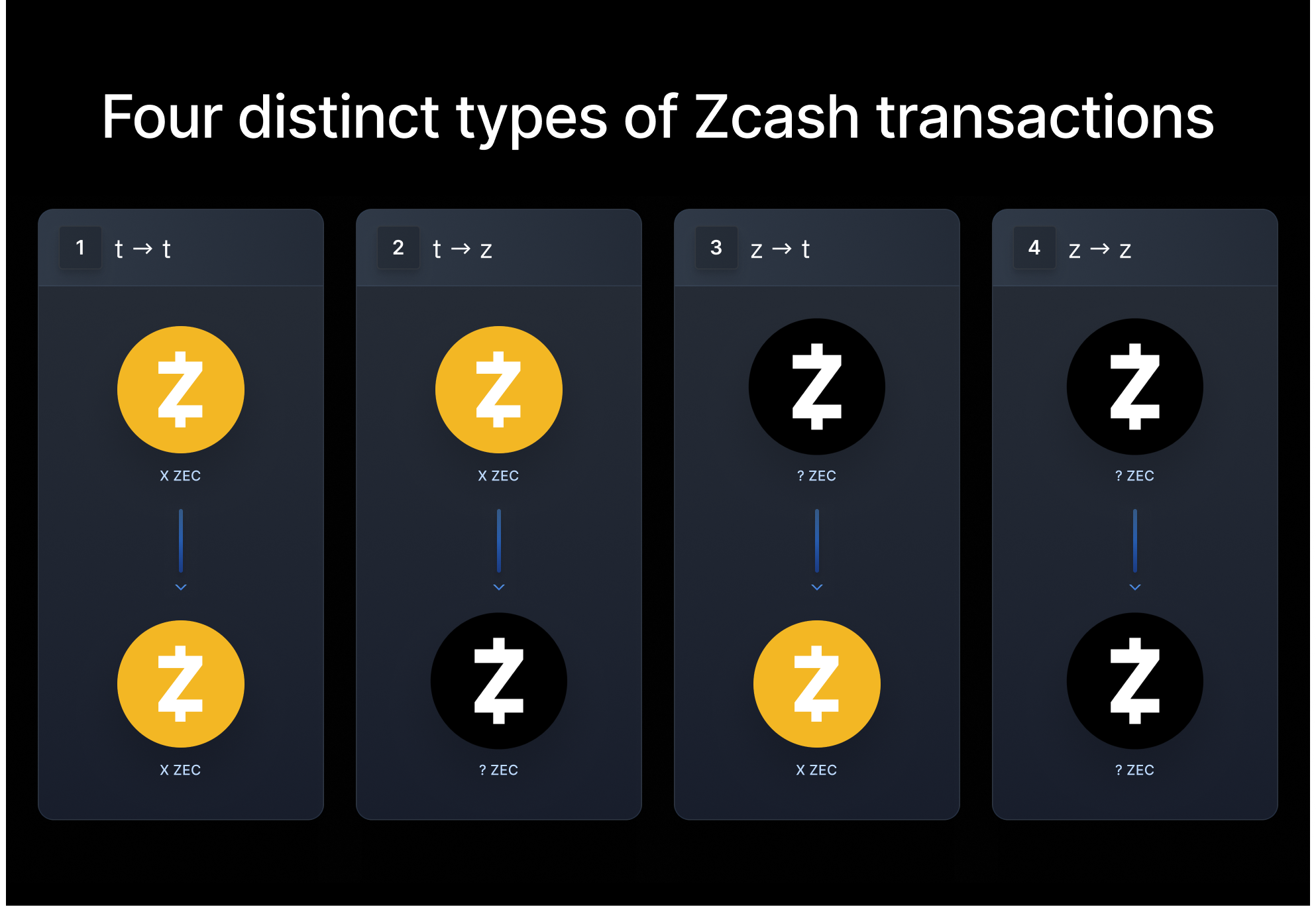
Zcash has two types of addresses: Transparent (t-addresses) and Shielded (z-addresses). Transparent addresses work exactly like Bitcoin addresses: all activity is publicly visible on-chain. Shielded addresses exist inside an encrypted pool where the sender, receiver, and amount are all hidden from outside observers.
This creates four distinct transaction types, each with a different privacy profile:
t → t (Transparent to Transparent): Fully public. Sender, receiver, and amount are all visible on-chain. This is identical to a standard Bitcoin transaction.
t → z (Transparent to Shielded): The amount being moved into the shielded pool is visible, but the recipient is hidden. Think of it as watching money walk through a door: you can see it go in, but not where it ends up.
z → t (Shielded to Transparent): The receiver and amount are visible, but the sender is not. The money emerges from the pool with no traceable origin.
z → z (Shielded to Shielded): Fully private. The only piece of data visible on-chain is the transaction fee. Sender, receiver, and amount are all cryptographically concealed.
In practice, the majority of Zcash activity has historically been transparent. Most exchanges and institutional players default to t-addresses for compliance reasons, which means a larger portion of Zcash's transaction history is readable than you might expect from a "privacy coin."
Tracking Zcash with Arkham
The conventional wisdom is that privacy coins are untraceable. Zcash complicates that picture significantly.
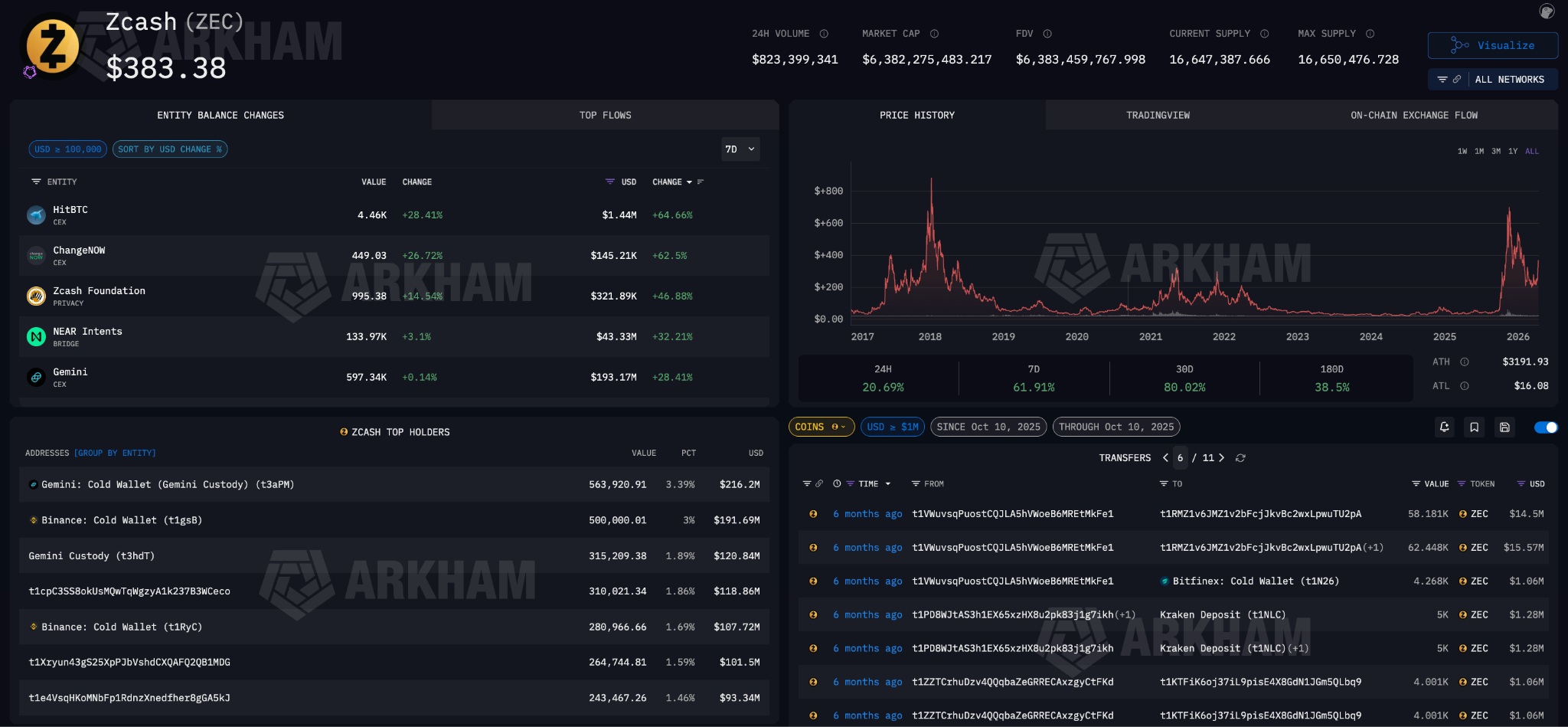
Arkham has now labeled more than half of all Zcash activity, attributing $420 billion in volume to known individuals and institutions. That figure is remarkable for a chain explicitly designed to obscure transaction data. It's possible because the majority of Zcash transactions are still transparent, and because on-ramps and off-ramps: exchanges, custodians, institutions, often maintain transparent addresses for ease of transfer.
Shielded transactions remain opaque: z → z activity cannot be tracked, and shielded addresses appear on Arkham labeled simply as 'SHIELDED.' But the entry and exit points are often visible, and that's where the intelligence lies.
Case Study: The U.S. Government's Zcash Holdings
One of the more unusual entries in Arkham's Zcash data is the U.S. Government itself. The USG wallet holds Zcash seized from Alexandre Cazes, the founder of the darknet marketplace AlphaBay, who was arrested in 2017. At the time of seizure, the holding was worth $737,000. Left untouched for eight years, it has since doubled in value. You can track the wallet in real time on Arkham.
Case Study: A $6.6M Profit Trade
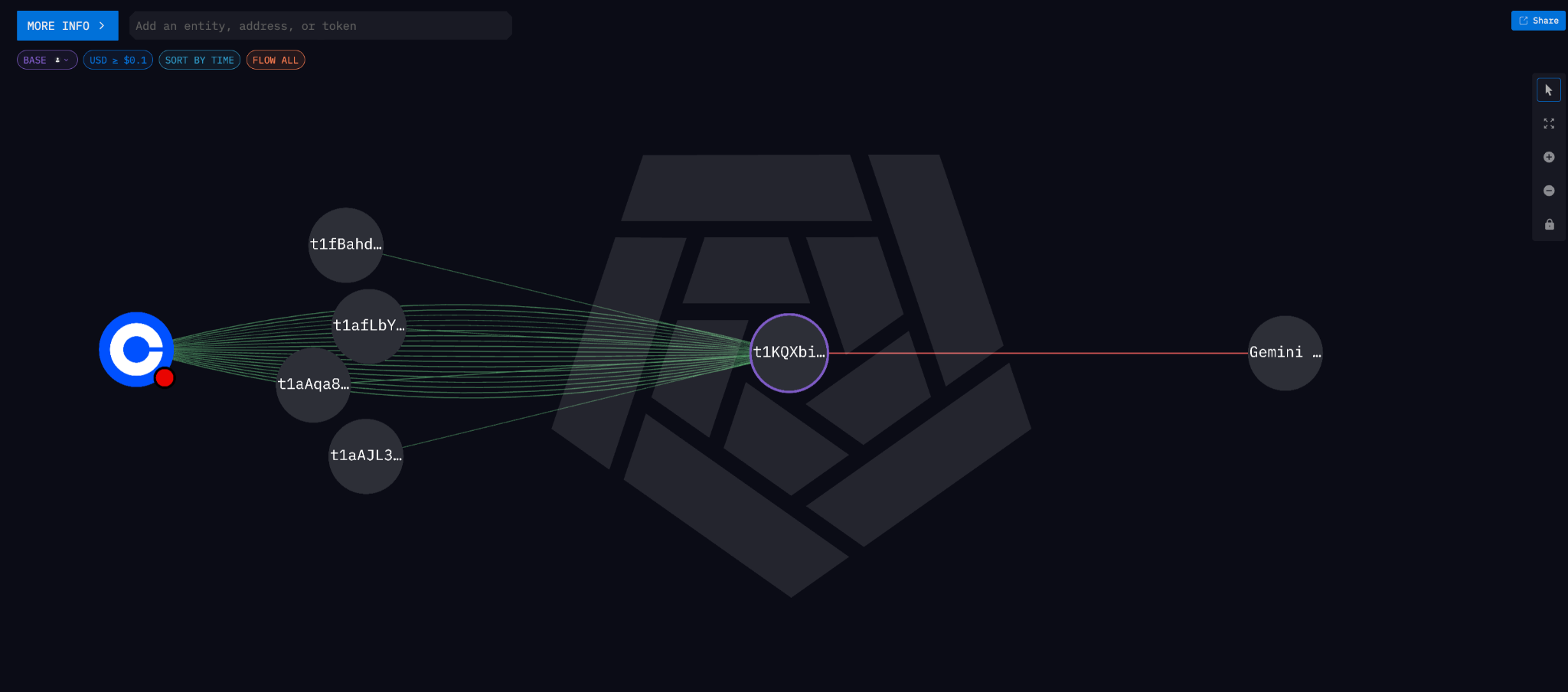
Arkham's data also surfaces individual traders making significant moves. One address acquired $4.49 million worth of Zcash during the market crash on October 10th, then held for five and a half weeks before transferring the coins to Gemini. If the position was liquidated at the time of deposit, the trader netted a $6.6 million profit. They more than doubled their original investment. The full transaction history is visible on Arkham, including the timing of each move and the exchange the coins were ultimately sent to.
Conclusion
Zcash sits at an unusual intersection. It is one of the most technically sophisticated privacy tools in crypto, and also one of the most misunderstood. The assumption that privacy coins are untraceable by default is not accurate. In practice, the majority of Zcash activity flows through transparent addresses, exchanges default to visible t-addresses for compliance reasons, and blockchain intelligence platforms like Arkham have attributed over $420 billion in volume to known entities on a chain explicitly designed to resist that kind of analysis.
That does not make Zcash's privacy guarantees weak. A z to z transaction remains cryptographically opaque. What it means is that how you use Zcash determines how private you actually are.
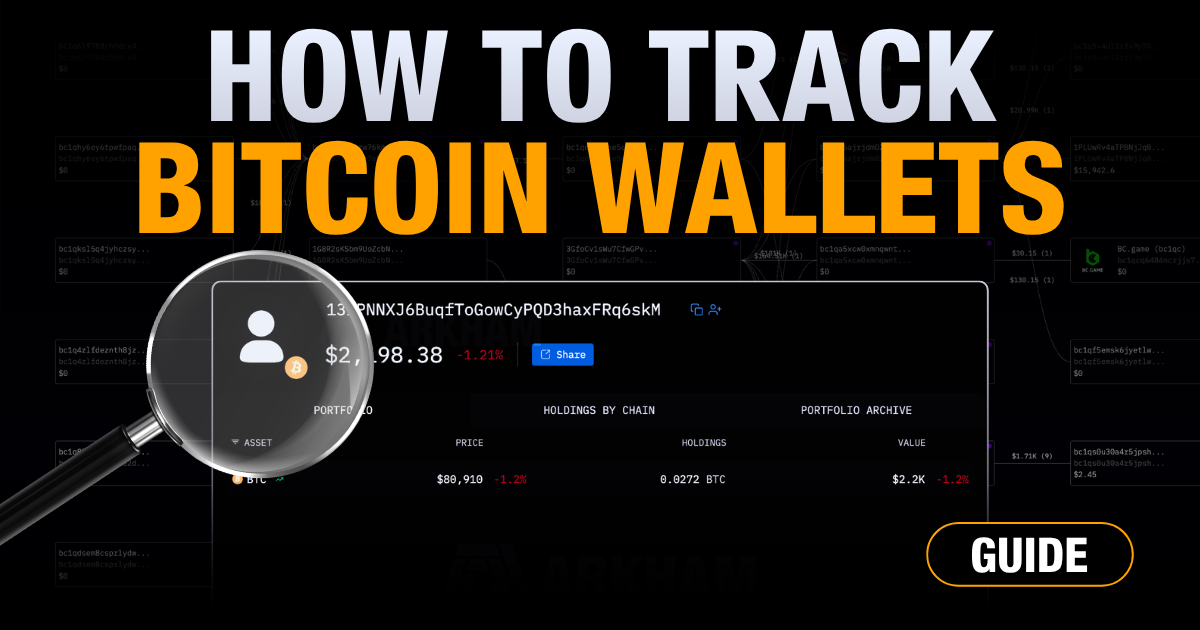
For anyone looking to explore Zcash activity firsthand, Arkham's coverage gives you the most complete picture available. Track ZEC transactions, entities and balances, set alerts for notable activity, and use Arkham's AI to surface insights across the network.

.png)







.jpeg)



.jpg)

.jpeg)


.png)





.png)
.jpg)

.png)
.png)

.png)
.png)
.png)
.png)
.png)
.png)



.png)
.png)
.png)
.png)



.png)