August 6, 2026
at
1:10 pm
EST
MIN READ
BlackRock's IBIT Buys Bitcoin Every Day This Week, Totalling $479M
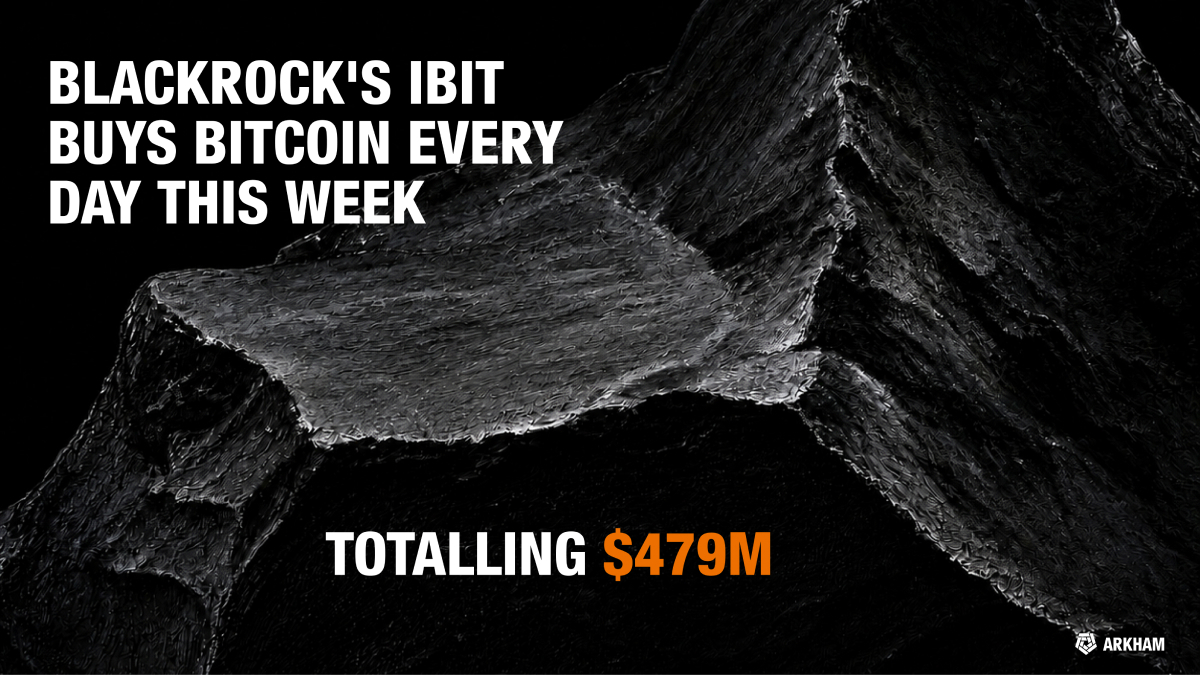
Recent Arkham data shows buyers of BlackRock’s IBIT net-purchased Bitcoin every single day this week, totaling $478.5M. The inflows appear as regular transfers from Coinbase Prime hot wallets directly into BlackRock IBIT addresses in batches of 250 to 300 BTC, bringing the entity’s tracked portfolio to approximately 742,000 BTC.
You can interact directly with BlackRock’s entity page on Arkham - including the asset manager’s portfolio, holdings by chains and portfolio archive - in the window below:
On-chain intelligence confirms this sustained institutional interest, revealing multiple same-day transfers from Coinbase Prime into BlackRock. This movement exactly matches public ETF flow data from SoSoValue.
In this period, IBIT - the largest Bitcoin ETF by a considerable margin - accounted for roughly 76% of all spot Bitcoin ETF inflows. (Total spot Bitcoin ETF inflows in this period were $626M).
Spot Bitcoin ETFs allow investors to gain exposure to Bitcoin through traditional brokerage accounts without taking custody of the underlying asset themselves.
For some investors, the convenience of ETFs have become increasingly appealing following the recent Coldcard incident. Self-custody remains the gold standard for many Bitcoin holders, but the hack was a reminder that securely managing private keys and hardware wallets is not straight-forward. ETFs eliminate many of those operational risks by placing custody in the hands of regulated financial institutions, making them an attractive option for investors who want Bitcoin exposure without managing wallets themselves.
Recent inflows have also fueled debate across Crypto Twitter over whether the market has found its bottom. Some argue that consistent institutional buying through products like IBIT signals strong underlying demand. Others remain cautious, suggesting macroeconomic uncertainty (e.g. interest rates) could still push Bitcoin lower.
BlackRock’s de-anonymized Arkham entity remains fully public, ensuring institutional numbers are verifiable in real time as they confirm on-chain. You can trace these exact ETF creations and monitor IBIT’s portfolio yourself using Arkham’s advanced blockchain intelligence platform.

.png)











.png)
.png)





.jpg)









.png)
.png)




.png)



.png)



.png)
.png)


.png)
.png)











.png)

.png)
.png)

.png)




.png)







.png)