June 12, 2026
at
9:25 am
EST
MIN READ
SpaceX: A Comparison of the Actual Stock vs the Perpetual Contract
.png)
The SpaceX IPO is here. At the opening bell in New York, June 12, SpaceX will target a valuation north of $1.7 trillion. While pre-IPO access to private markets has been restricted to accredited investors and institutions, DeFi protocols like Hyperliquid have - over the last few weeks - given retail traders an alternative route.
As the opening bell approaches, market participants face a choice between purchasing traditional equity or using decentralized derivative contracts.
Here is a breakdown of both. We factor in the mechanics of each option, the objectives of the trader/investor, and the risk appetite of the trader/investor.
Equity
Purchasing the actual SpaceX stock provides certain rights that synthetic assets typically do not match. These rights reduce the trader’s exposure to certain risks.
Advantages:
- Buyers acquire ownership over actual SpaceX equity.
- Investors receive primary-market IPO allocations, dividends (if any), and voting rights (where conferred).
- After the IPO, the stock will track the ‘real’ public equity price of the company.
- Emotional: A stock holder may feel more committed to the company’s prosperity, especially if a long-term investor, through holding an actual slice of the business.
Disadvantages:
- Prior to the IPO, exposure is completely gated and inaccessible to many retail traders.
- Purchasing standard shares does not often offer the ability to easily use leverage for extra exposure.
The Perpetual Contract
The SPCX contract deployed by TradeXYZ operates on Hyperliquid's HIP-3 upgrade and has acted as a pre-IPO discovery mechanism.
Advantages:
- The contract allows users to take long or short positions on the implied share price of SpaceX.
- Retail traders can access pre-market exposure (trade the position before it officially launches).
- Speculators can use leverage.
Disadvantages:
- Holding a SPCX contract confers no ownership over actual SpaceX equity. The instruments are derivatives that track the price.
- Active SPCX perp positions do not become actual stock upon IPO.
- According to the perp contract, the implied valuation of SPCX is $2.3T (at the time of publish). This is higher than the actual IPO price (either pricing in a Day 1 price pop, or a premium for access, or something else entirely, depending on your opinion).
- Liquidation risk if using leverage. A flash crash (either from low liquidity or technical issues) could cause loss of the entire position.
Long-Term Holding vs. Quick Profit
If the objective is to hold for a long time, traditional equity could be the wiser choice. Real SpaceX shareholders will benefit from potential dividends and voting rights.
Traders seeking a quick profit might prefer to opt for decentralized perpetual markets. Here, traders can speculate on pre and post-IPO volatility. After the IPO, these active SPCX positions transition into standard stock-linked perpetual futures. This allows derivative traders to capture price movements both before and after the IPO.
Risk Appetite
Personal risk tolerance certainly affects one’s choice of instrument, or whether one chooses to participate at all. Perpetuals often appeal to those with higher risk tolerances because of the availability of leverage and the premium pricing currently attached to the asset, in exchange for early live trading access.
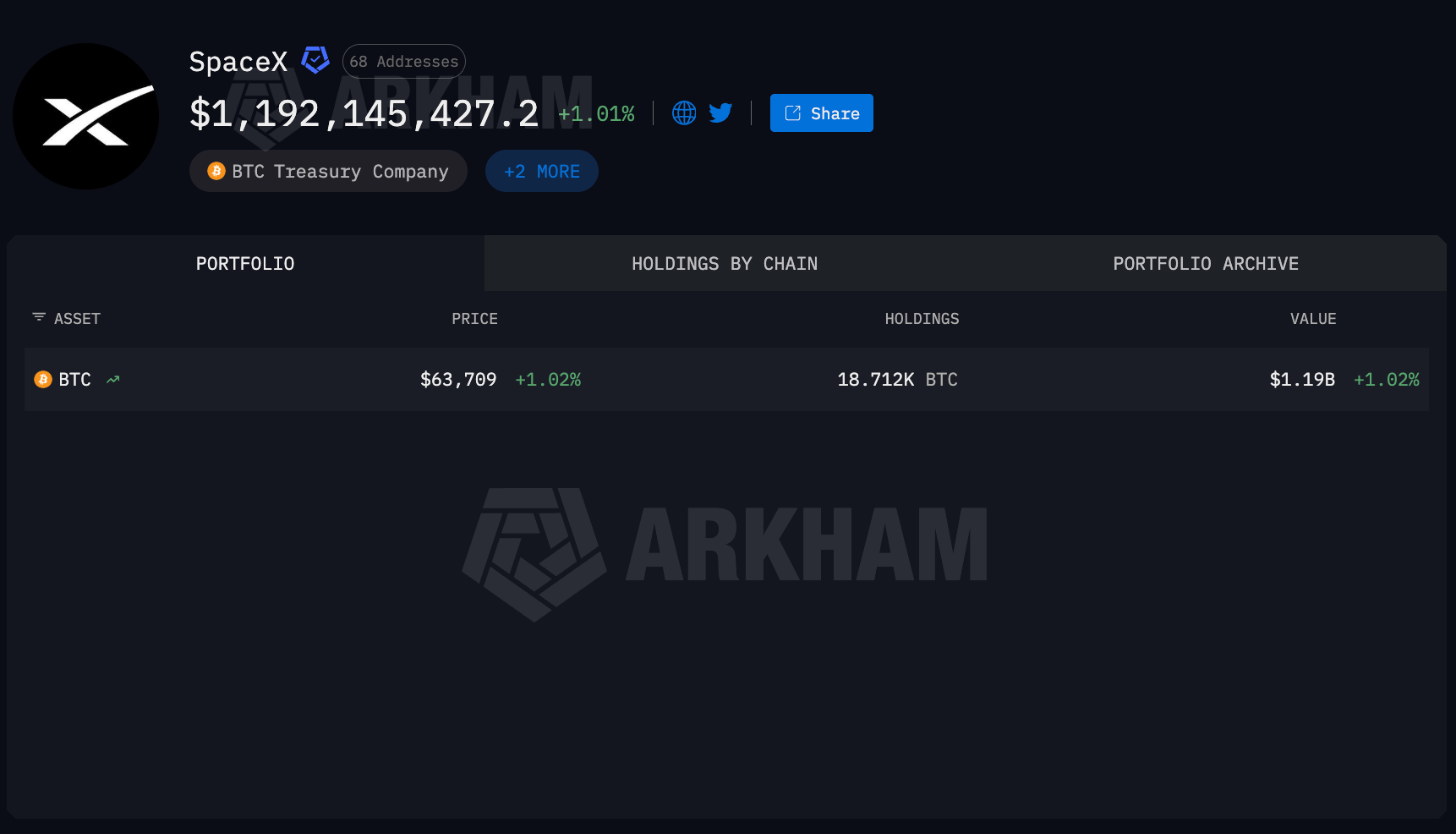
Stock buyers and derivative traders may also wish to take note of SpaceX's balance sheet. SpaceX will become the eighth largest publicly traded BTC treasury company after its IPO. It holds 18,712 BTC.
Arkham was first to publicly identify the on-chain holdings of SpaceX. You can track SpaceX directly on Arkham here.

.png)









.jpeg)

.png)













.png)









.jpg)


.jpeg)











.png)

.jpg)



.png)
.png)



.png)


.png)
.png)
.png)


.png)
.png)








.png)
.png)