June 15, 2026
at
5:00 am
EST
MIN READ
UTXO Explained: Bitcoin’s Most Underrated Innovation
Bitcoin's architecture is built on several interlocking ideas, and most notably: the fixed supply, proof-of-work mining, the blockchain itself. However, UTXO, the accounting system that makes all of it actually function at the transaction level, rarely gets the same interest outside of technical circles.
Understanding UTXO is not just an academic exercise; it explains why Bitcoin behaves like cash rather than a bank account, why its privacy works the way it does, and why Satoshi Nakamoto's original design holds up as well as it does nearly two decades later.
Summary
- UTXO is the accounting method that tracks available funds as discrete, spendable units rather than account totals.
- While pioneered by Bitcoin, this model has been adopted by several other prominent blockchains including Litecoin, Dogecoin, and Zcash.
- UTXO was designed to solve the double-spending problem, Bitcoin's core technical challenge, by making every coin traceable back to its original source without requiring a central authority.
- The UTXO model can improve privacy when combined with good address-management practices, since new output addresses are generated with each transaction, rather than persisting in an account throughout.
What Is UTXO?
Most people view traditional finance accounts as a container. You can check its balance, spend from it, and the number goes up or down accordingly. UTXO is a completely different accounting system. Bitcoin does not store coins inside wallets. Wallets store keys that allow users to spend UTXOs recorded on the blockchain. Rather than tracking a running total in an account, a UTXO-based blockchain tracks individual units of unspent value, each one like a sealed envelope with a specific amount inside, controlled by whoever holds the corresponding private key.
When you receive Bitcoin, what you actually receive is a UTXO: a confirmed output from a prior transaction that is now assigned to your address and has not yet been spent. When you send Bitcoin, you are not drawing down a balance. Instead, you are consuming one or more of those envelopes entirely, and the network creates fresh outputs in their place, one going to the recipient and, if inputs exceed the payment amount, another returning the remainder as change.
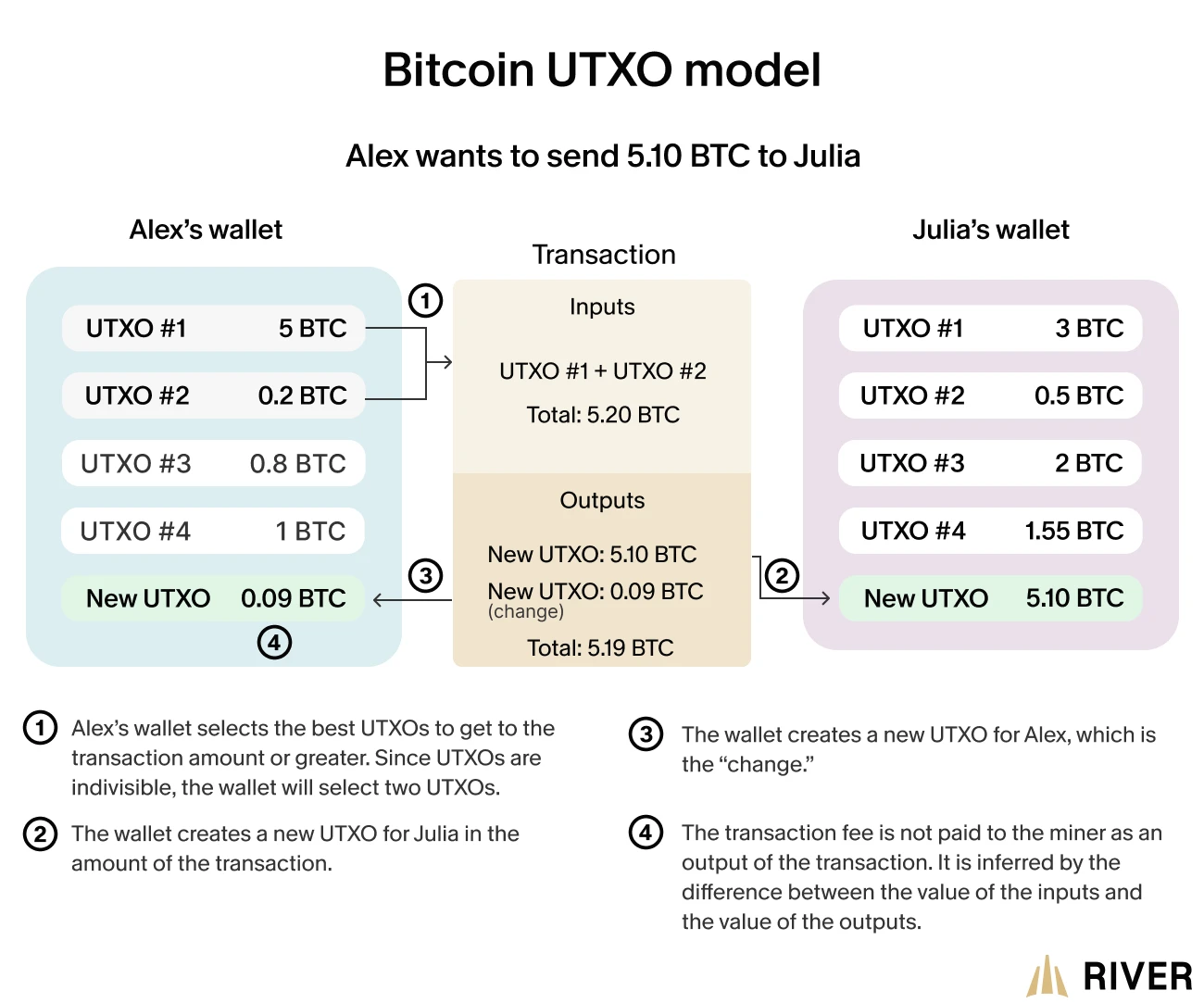
That change output is itself a new UTXO, sitting unspent until you decide to use it. At any given moment, the "balance" shown in a Bitcoin wallet is simply the sum of all the UTXOs currently assigned to your addresses.
Which Blockchains Use UTXO?
The UTXO model originated with Bitcoin and was inherited by most of its direct descendants. Bitcoin Cash, Litecoin, Dogecoin, Zcash, and Dash all retain the model, having forked from Bitcoin's codebase. Cardano uses a modified version known as the Extended UTXO (eUTXO) model, which adds programmability for smart contracts while keeping the core UTXO accounting structure intact.
By contrast, Ethereum and the many networks it inspired, including Tron, Solana, and BNB Chain, use the account-based model, where balances are stored directly against persistent addresses rather than as collections of independent outputs. This resembles the account-based systems used in traditional finance.
Satoshi Nakamoto’s UTXO Comments
Interestingly, despite UTXO being core to the Bitcoin architecture, the term UTXO does not appear anywhere in the Bitcoin whitepaper, published in October 2008. The phrase itself was never coined by Nakamoto, but rather emerged later among developers between 2011 and 2012 as shorthand for a concept the whitepaper describes.
The clearest articulation comes in Section 9, titled "Combining and Splitting Value". Nakamoto writes that rather than handling every coin individually, transactions should be able to carry multiple inputs and outputs at once, with one output for the payment and one returning change to the sender. That is a precise description of how UTXOs function in practice.
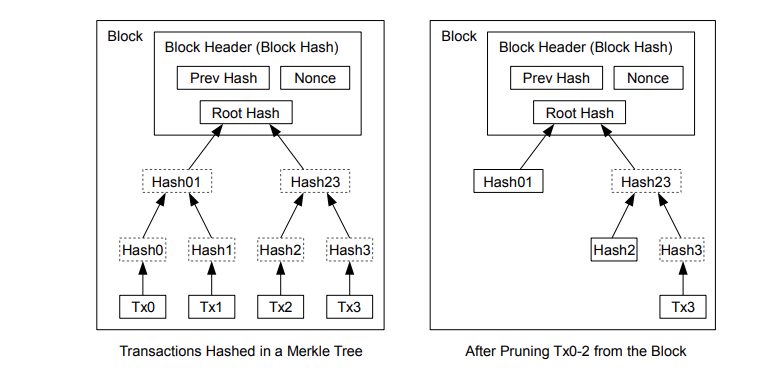
In Section 7 "Reclaiming Disk Space", Nakamoto also touches on UTXOs, though indirectly. Nakamoto addresses the concern that storing all this transaction data could become unmanageable. His answer was that spent transactions could be pruned from the chain using a Merkle tree structure, leaving only block headers and unspent outputs intact. Crucially, Nakamoto calculated at the time that block headers would amount to roughly 4.2 MB of storage per year, a figure he considered manageable against the trajectory of consumer hardware capacity. The underlying point was that the UTXO set, the full database of unspent outputs, was always intended to be a compact, practical data structure rather than a scalability problem.
The spirit behind UTXO runs deeper than technical efficiency. Nakamoto titled the paper "Bitcoin: A Peer-to-Peer Electronic Cash System," and the framing was deliberate. The design mimics physical cash: discrete units, no intermediaries, no persistent account required to receive or spend value. Nakamoto's frustration with systems where every transaction must route through a central authority, described in the whitepaper as the reliance on a "trusted third party," shaped the entire architecture. UTXO was one expression of that philosophy.
UTXO vs Account Model
Aside from UTXO, the other dominant blockchain accounting model is the account model. The account model, which Ethereum popularised, functions like a conventional bank ledger. Each address has a balance associated with it, and transactions adjust those balances up or down. It is intuitive, mirrors how most people think about money, and simplifies smart contract logic because contracts can read and update state from a single source of truth.
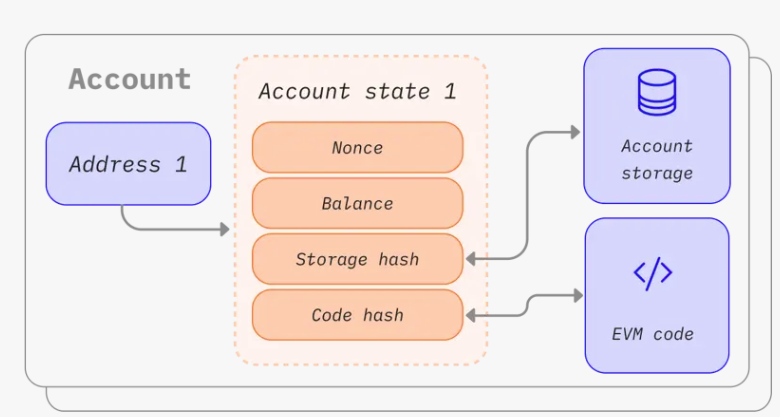
UTXO takes the opposite approach. There is no balance stored anywhere on-chain for a given address. Instead, a network node scans all unspent outputs assigned to that address and adds them up to derive the account balance. Each UTXO is an independent object with its own spending conditions, contrary to the account model, where balances are represented as a single account state rather than separate outputs.
The account model is simpler for developers building applications that need shared, mutable state. This is why most DeFi protocols are built on Ethereum-derived chains. UTXO, however, has structural advantages in three areas.
First, transaction validation is more parallelisable. Since each UTXO is independent and can only be spent once, different transactions consuming different UTXOs can be verified simultaneously without conflicts. This is more difficult in account-based systems, where two transactions updating the same balance must be ordered carefully to prevent double spending.
Additionally, UTXO makes it harder to accidentally or maliciously replay a transaction on a different chain, since the specific outputs being consumed are tied to the transaction graph of the originating network.
Third, and most relevant to everyday users, UTXO provides a natural layer of privacy. Each transaction generates new output addresses, meaning the same person does not necessarily reuse a single observable address across every payment.
Significance of UTXO
Solving Double Spending
Before Bitcoin, the central obstacle to digital cash was double spending: the ability to copy a digital file and spend it twice. Physical money cannot be duplicated this way, but digital data can. Prior attempts at electronic cash relied on a central server to maintain a single authoritative ledger, which reintroduced the trusted intermediary problem.
UTXO solves this without the need for a central authority. Every UTXO can be traced back through the transaction graph to its origin, typically a coinbase transaction. Once a UTXO is consumed as an input, it is permanently marked as spent in the chainstate database maintained by network nodes. No node will accept a second transaction attempting to spend the same output. The history is public, auditable, and tamper-resistant.
Privacy
UTXO provides structural privacy by discouraging address reuse. The change resulting from each transaction is returned as a fresh output to a new address, and because wallets typically generate a new address for each incoming transaction, it is harder to build a complete picture of any individual's holdings just by observing the chain. This is a meaningful property compared to account-based systems, where a single address accumulates an unbroken transaction history.
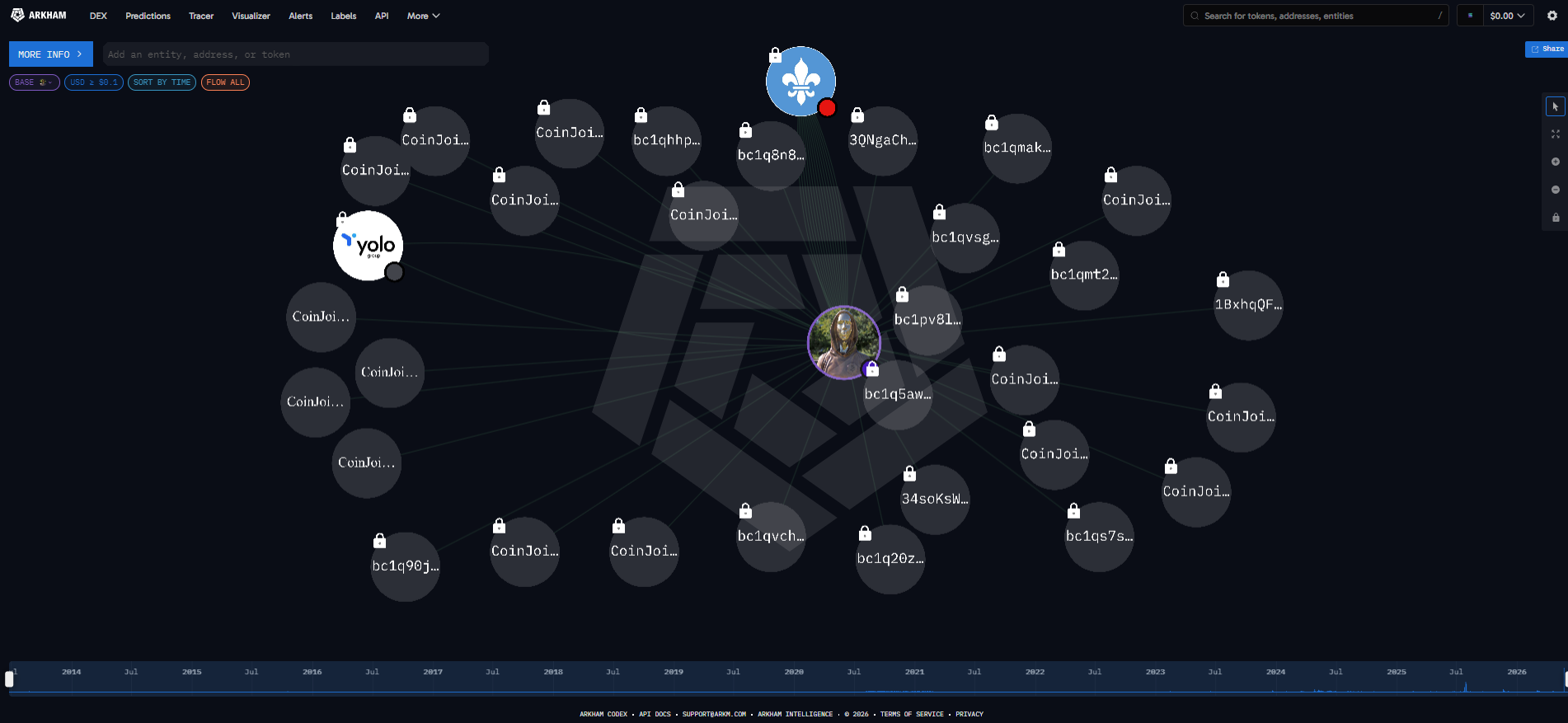
That said, UTXO is not anonymous. The transaction graph is fully public, and tools like Arkham can trace funds across complex chains of UTXOs, cluster addresses belonging to the same entity, and attribute wallet activity to known organisations or individuals. Privacy-focused UTXO-based networks such as Zcash extend privacy further using zero-knowledge cryptography, but Bitcoin's base layer does not obscure transaction amounts or addresses. The privacy UTXO provides is better described as pseudonymity, a weaker property that determined on-chain analysis can often pierce.
A Response to Fractional-Reserve Banking
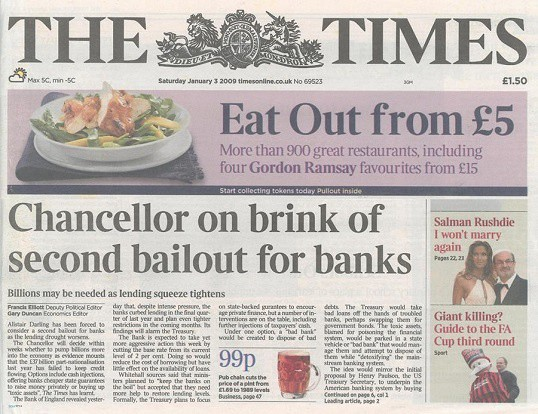
Nakamoto embedded a message in Bitcoin's genesis block in January 2009, a headline from UK’s The Times newspaper: “Chancellor on brink of second bailout for banks”, relating to the ongoing impact of the 2008-2009 financial crisis. Historians and Bitcoin researchers have widely interpreted this as a deliberate commentary on the instability of a financial system built on fractional-reserve banking, where institutions lend out far more than they hold in reserve, creating systemic risk.
UTXO fits directly into this philosophy. Bitcoin’s consensus rules prevent arbitrary creation of new coins. The UTXO model reinforces this by requiring every spendable output to have a verifiable history. Every unit of value in circulation has a verifiable origin and a complete on-chain history. There is no on-chain equivalent of a bank creating credit out of thin air. Whether or not one agrees with Nakamoto's critique of conventional banking, the UTXO architecture reflects a specific and coherent vision: that sound digital money should behave like physical cash, not like an easily mutable entry in someone else's database.
Conclusion
UTXO has never been Bitcoin's most discussed feature. Compared to proof-of-work or the fixed 21 million supply cap, it attracts relatively little attention outside technical circles. But it is foundational to its design and arguably crucial to its success.
Without it, Bitcoin's double-spend solution would not hold, its privacy properties would not exist, and its cash-like character would be purely theoretical. The model Nakamoto described in 2008, without ever naming it, now underpins trillions of dollars in cumulative economic activity across multiple networks, and it remains one of the more durable ideas in the history of cryptographic systems.

.png)











.png)
.png)




.jpg)







.png)

.png)


.png)


.png)



.png)
.png)


.png)
.png)









.png)
.png)
.png)
.png)




.png)








.png)