September 21, 2026
at
6:30 am
EST
MIN READ
How To Use A Blockchain API

A blockchain API is a software tool that allows you to connect your own applications to blockchains and access real-time data from them. Blockchain APIs come in many different formats.
The Arkham API is a tool that provides real-time blockchain data across all the major chains, leveraging Arkham’s extensive database of de-anonymized entities, tags, and labels.
Hedge funds, market makers, exchanges, and governments use it for a range of tasks from trading and compliance to deep on-chain investigations and more. You can access a 30-day trial of the API here and build your own custom system on top of Arkham’s blockchain data.
This is our guide on how to do this.
Using The Arkham API
Here is how to get started. You do not need to be a developer - if you are using AI, let it do most of the technical work, and whenever you need to write code or use the terminal, ask the AI exactly what to type.
Step 1: Get access. Start a trial on the Arkham API page. Scroll to the bottom, fill out the form, and you’ll receive a 30-day trial. Once you have access, generate your API key at and store it somewhere safe and never share it publicly - anyone with your key can run up a bill on your account.
Before moving on, skim the API documentation so you understand what the API can do. You do not need to memorise it. The AI will handle the details.
Step 2: Download Claude Desktop. The connection method below uses a Model Context Protocol (MCP) server - a small bridge file that lets Claude call the Arkham API as a tool. This requires the free Claude Desktop app, not the browser version.
Step 3: Build the MCP server. You will not write this yourself. Open Claude Desktop and paste the setup prompt from the Arkham API documentation. Claude will generate a Python file and tell you exactly where to save it on your machine.
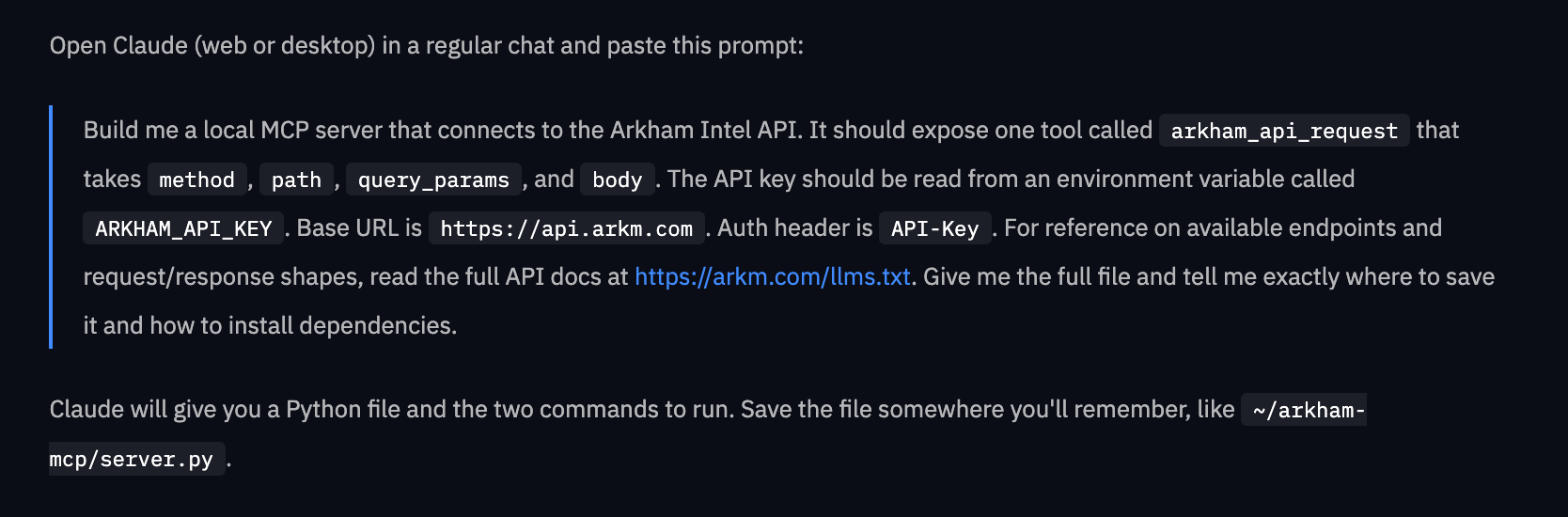
Step 4: Install the dependencies. Open your Terminal and run the command Claude gives you - typically “pip install mcp requests”. This is the only command you will type by hand, and you can paste it directly.
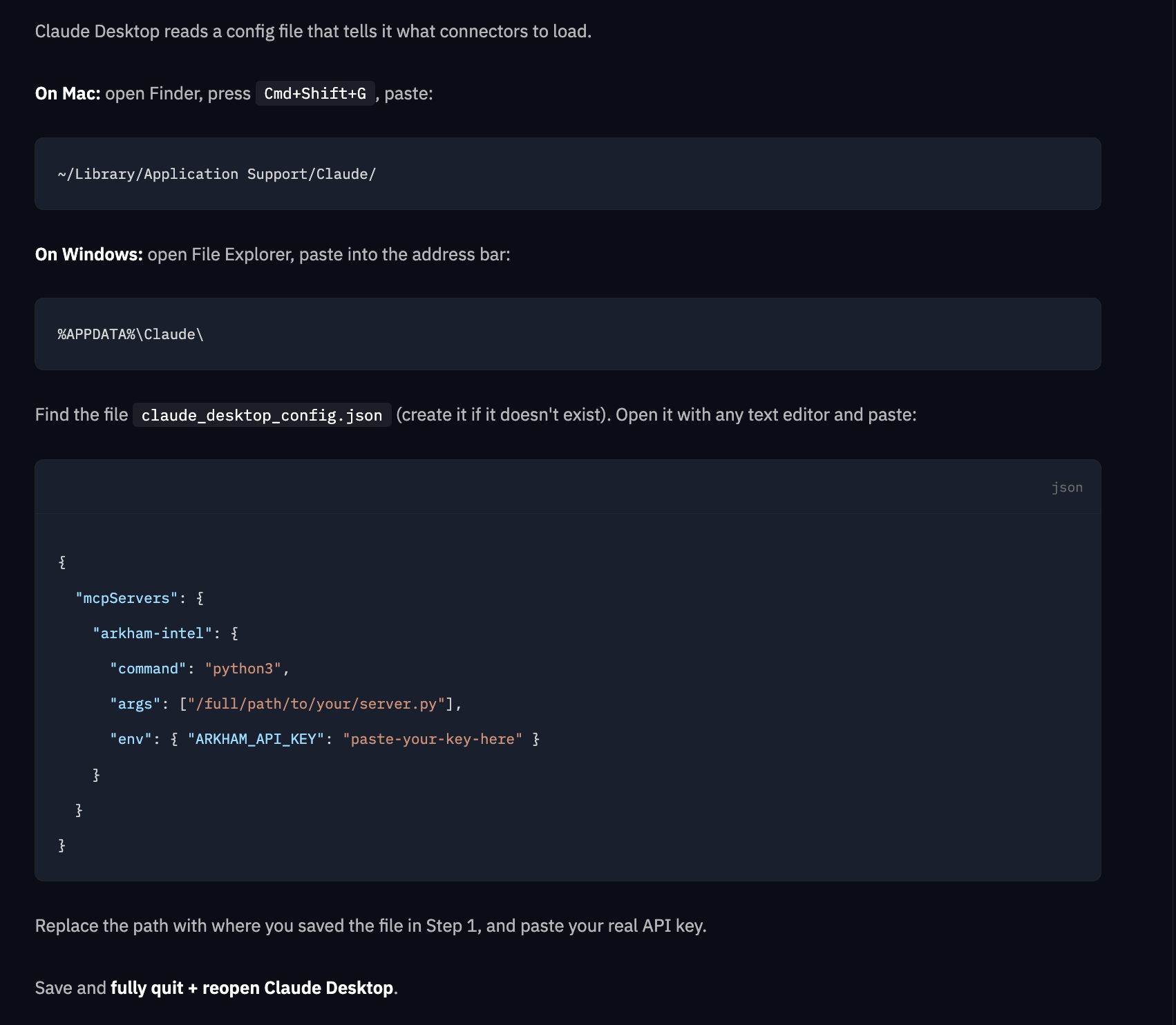
Step 5: Connect it to Claude Desktop. Add a short JSON configuration snippet - provided in the same docs - pointing to your new server file and your API key. Your key lives in this config file on your own computer. This is very different from pasting a key into a chat window, where it leaves your device - never do that. Save the config, quit Claude Desktop, and reopen it.
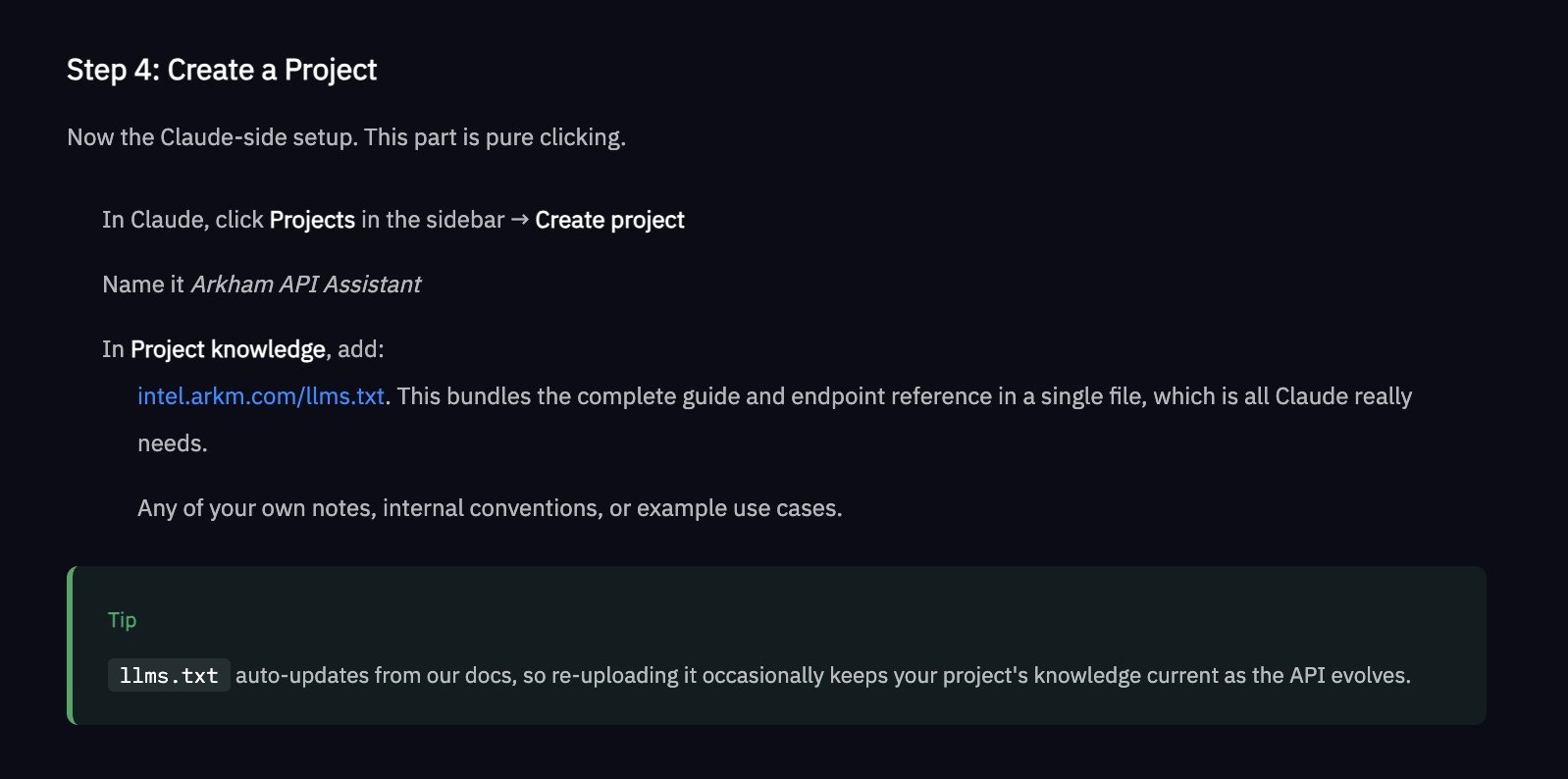
Step 6: Give Claude the full API reference. Inside Claude, create a new Project in the sidebar and name it "Arkham API Assistant". Add https://intel.arkm.com/llms.txt as project knowledge. This URL gives Claude a complete reference for the entire API.
That is the setup done. Now ask a live question. E.g. "pull the top 10 counterparties for Binance's hot wallet on Ethereum over the last seven days". Claude will pick the correct endpoint, make the live API call, and return the data in your chat window.
What To Do With Blockchain Data API
Now that your API is set up, here are a few examples of useful tools you can build.
Trading Strategy
Problem: By the time a new token or narrative trends on crypto Twitter, the massive gains have usually already been made by insiders and elite traders.
API Solution: Build a script that identifies the early signs of whale movements.
How: Identify 20 to 30 highly successful, low-profile venture funds, market makers, or solo traders using Arkham’s labeled entities. The Tags Leaderboard at https://intel.arkm.com/tags can help with this. Your tool will scan the blockchain for instances where three or more of these distinct, unrelated smart money entities interact with the same new, unlabeled smart contract within a 48-hour window.
Output: A Telegram or Discord bot that pings you saying: "Alpha Alert: Paradigm, Wintermute, and an anonymous whale wallet tracked by Arkham have all just interacted with Contract X in the last 12 hours."
Why: Institutions and whales leave footprints on-chain long before the average retail trader hears about it on Crypto Twitter. This tool means you can see the trade forming rather than the ensuing narrative, at which point it’s already too late.

Compliance
Problem: Exchanges, OTC desks, and funds are legally liable the moment they engage with a sanctioned wallet, a mixer, or funds tied to illicit activity. Checking every counterparty by hand is slow, and missing one suspicious address can result in a regulatory breach.
API Solution: Build a screening tool that checks any wallet address or entity against Arkham's labeled entities and risk tags before funds move. You can also use the Risk Scores API add-on which does this exact thing for you.
How: Risk Scores grade addresses and entities according to how connected they are to known or suspected illicit operations. The system assesses all funds sent from and received by the specific address or entity in question. It then calculates the final score using a weighted average of exposure across several risk themes.
Output: A pass/fail compliance report: "Flagged: this address has a high Risk Score. Hold for manual review."
Why: Manual screening does not scale, and one missed address can count as a regulatory breach. Automating the check means every counterparty gets screened against the same standard.
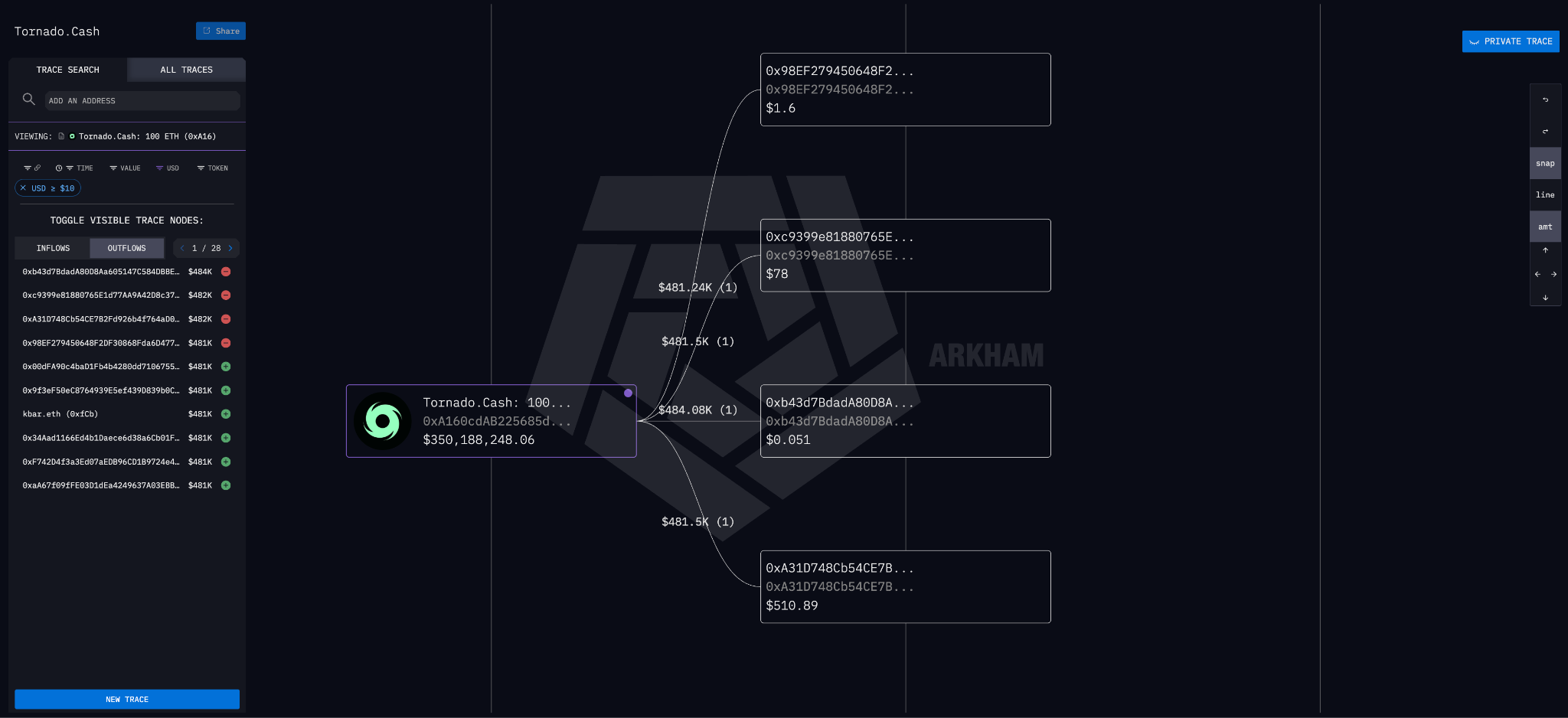
Fraud Detection
Problem: Unfortunately, fraud is common in crypto. Drainers, rug pulls, and phishing contracts can empty a wallet in a single transaction.
API Solution: Build a threat monitor that watches a set of wallets and flags suspicious activity in real time.
How: Load a watchlist of your own addresses or those belonging to a client. Whenever one of them interacts with a contract or address, check the counterparty against Arkham's scam, suspicious, and ransomware labels. Watch for red-flag patterns, such as a token approval to a known drainer, funds heading to a freshly deployed contract, or a sudden liquidity pull.
Output: An instant Telegram or Discord alert: "Fraud Alert: Wallet X just approved token spending to a contract Arkham has tagged as a known scam address. Revoke the approval now."
Why: Catching a malicious approval in the window between signing and draining is the difference between revoking a permission and losing everything in it.
On-Chain Analytics
Problem: Spot ETF flows are one of the clearest signals of institutional demand in the market, but most people only ever see them as a figure in a daily report. You can actually verify ETF flows directly on-chain.
API Solution: Build a tool that tracks ETF inflows and outflows directly by monitoring the custody wallets behind the major spot ETFs.
How: Arkham has labeled the wallets belonging to the ETF issuers and their custodians, with Coinbase holding a large share of them. Pull the balance history of those addresses and watch the coins move. Net inflows show up as crypto landing in custody, while redemptions appear as crypto leaving. Roll this data up into a daily and weekly net figure per issuer.
Output: An interactive HTML dashboard or alert: "ETF Flow Watch: spot BTC ETF custody wallets took in ~1,200 BTC over the last 24 hours, the largest single-day inflow this month."
Why: ETF flow reports arrive on a delay and ask you to trust the reporter. The blockchain is the ultimate source of truth when it comes to inflows and outflows. Reporting also happens on a lag time. On-chain movements can help you verify activity faster than the official reports.
Start Building With a Blockchain Data API
The blockchain is a transparent financial network. To make sense of it, traders, investors and institutions require the right tools. Blockchain APIs are a great way for institutions to make sense of the blockchain, whilst also integrating into their current systems.
The Arkham API provides real-time access to the largest database of de-anonymized blockchain entities. This allows you to transform on-chain data into actionable analytics, whether you are tracking institutional flows, screening for compliance, or identifying alpha before it goes stale.
Nowadays, you do not need an engineering background to execute these ideas; you can let an AI handle the technical details. By pairing the Arkham API with an AI assistant in a local environment, you can build custom on-chain applications quickly and securely.
The only limit is what you decide to track. Whether you are automating a trading strategy, creating a custom analytics dashboard, or securing client funds against fraud, the infrastructure and data is already there.

.png)

.jpeg)






.jpg)


.jpeg)






.png)









.png)

.jpg)



.png)
.png)



.png)

.png)

.png)
.png)


.png)
.png)







.png)
.png)
.png)

.png)



.png)