September 29, 2026
at
7:20 am
EST
MIN READ
U.S. Government Bitcoin Holdings 101
.jpg)
SUMMARY
- The U.S. Government is the largest sovereign holder of Bitcoin with roughly 325,000 BTC worth about $28 billion (at the time of writing), spread across hundreds of Arkham-tracked wallets.
- The vast majority of this Bitcoin was obtained from law enforcement seizures and forfeitures from cases such as the Silk Road and Prince Group.
- The US Government has sold off close to 195,000 BTC from seizures over the years, but this practice stopped when President Trump signed an executive order creating a Strategic Bitcoin Reserve and switched the United States to a policy of holding instead.
- A smaller separate Digital Asset Stockpile holding other seized cryptocurrencies exists, primarily consisting of Ethereum.
HOW MUCH BITCOIN DOES THE US GOVERNMENT HAVE?
Arkham’s on-chain data puts the US Government’s Bitcoin holdings at ~325,000 BTC, which is worth roughly $28 billion at current prices. These coins are spread across hundreds of separate wallets. Some of these coins have been sitting idle in cold storage for over a decade, some are being held by various federal agencies, and some have been consolidated into Coinbase Prime for custody.
These Bitcoins represent roughly 1.6% of the total Bitcoin supply. The US Government is the largest holder of Bitcoin among all sovereign governments. The next largest sovereign holder Arkham has de-anonymized is the United Kingdom, which holds over 61,000 BTC. It is worth noting that the Chinese government may hold more Bitcoin than the United Kingdom (China seized ~190,000 BTC in 2019 but this is widely thought to have been sold). China’s wallets are not as transparently tracked.
Arkham’s attribution of 325K BTC to the US Government is a collection of every wallet that has been linked to a federal agency, regardless of legal status. A Freedom of Information Act Request that was submitted to the Department of Justice in March 2025 returned a response of 28,988 in Bitcoin being held with the US Marshals Service. This number only counts Bitcoin that the US Marshals have formally taken title to. It excludes Bitcoin that is sitting in FBI or DEA evidence wallets while a case works through the courts, even though that Bitcoin is being held by a government agency.
WHEN DID US GOVERNMENT ACQUIRE ITS BITCOIN?
The US Government has acquired its Bitcoin over the years from various arrests and seizures. Here is the timeline of notable US seizures:
- October 2013: FBI agents arrest Silk Road founder Ross Ulbricht and shut down the Silk Road dark web marketplace. Approximately 26,000 BTC was seized directly from the website’s servers and 144,336 BTC was seized several weeks later from Ross Ulbricht himself.
- November 2020: The DOJ files a civil forfeiture complaint against 69,370 BTC that had been sitting idle in a wallet since 2013. This wallet had been traced to a hack of the Silk Road marketplace, and prosecutors referred to the hacker as “individual X”.
- November 2021: Federal agents raided a home in Gainesville, Georgia and were able to retrieve roughly 50,676 BTC that was hidden in a floor safe and a popcorn tin. The homeowner is revealed to be James Zhong, who had hacked the Silk Road using fake vendor accounts and a bug in the Silk Road’s withdrawal system.
- February 2022: Following the arrest of 2016 Bitfinex hacker Heather Morgan and husband Ilya Lichtenstein, federal investigators were able to recover roughly 94K BTC. The original hack was for 119,754 BTC, but the couple had laundered portions of that Bitcoin into other assets such as cash, USD stablecoins, and gold. Two smaller follow-up recoveries brought the total Bitcoin recovered closer to ~108,000 BTC.
- October 2025: The US Department of Justice unseals an indictment against Chen Zhi. The Chinese-Cambodian businessman was the chairman of Prince Group, a shady business conglomerate that had ties to cybercrime and online scamming. A civil forfeiture was also filed, and the US Government gained control of 127,271 Bitcoin, the largest forfeiture in Department of Justice history. These coins were traced back to a theft in 2020 from a Chinese mining pool.
WHERE DID US GOVERNMENT GET ITS BITCOIN FROM?
The vast majority of the US Government’s Bitcoin has come from law enforcement cases over the years. Here are the major cases that led to significant amounts of Bitcoin ending up in government wallets.
A large portion of the US Government’s Bitcoin came from the Silk Road and its founder Ross Ulbricht under the pseudonym “Dread Pirate Roberts”. The Silk Road was the first major dark web marketplace, where users could purchase and sell drugs and other illegal goods using Bitcoin. Ulbricht took a small portion of every transaction that occurred on the Silk Road as a commission. When the FBI shut down the Silk Road in 2013, agents were able to seize the ~26,000 BTC sitting on the marketplace’s servers. The FBI was then able to track down a much larger stash of 144,336 BTC on Ulbricht’s personal laptop, seizing it while he was sitting in the San Francisco library.
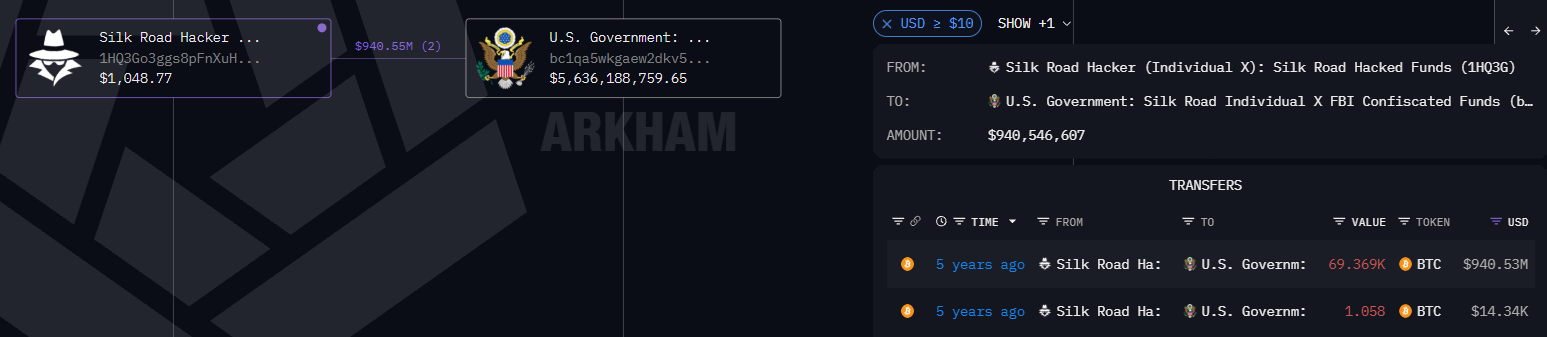
In November 2020, the Northern District of California's US Attorney’s Office filed a civil forfeiture complaint for 69,370 BTC, as well as matching amounts of Bitcoin forks such as Bitcoin Cash, Bitcoin Gold, and Bitcoin SV. The wallet containing these assets had been sitting idle since 2013. Prosecutors reported that its holder, “Individual X”, had managed to hack the Silk Road and move funds from the marketplace to hacker controlled wallets, but gave no details on how the hack was performed. According to the filing, Ulbricht became aware of Individual X’s identity and threatened him, demanding the return of the stolen Bitcoin. Individual X did not comply, holding the coins and barely using them. Over eight years later, Individual X signed a consent agreement with the US government where in return for anonymity the stolen Bitcoin was handed over to the government.

In September 2012, James Zhong created fake vendor accounts on the Silk Road and discovered that rapidly double-clicking the withdrawal button allowed him to withdraw more Bitcoin that he’d deposited. James proceeded to abuse this bug across ~140 transactions in quick succession, walking away with close to 50,000 BTC as a result. James spent the next decade of his life hiding his stolen fortune, running the proceeds through a Bitcoin mixer and an overseas exchange to launder the coins. Investigators eventually caught up with him in 2021, raiding his house in Gainesville, Georgia and finding 50,676 BTC split between an underground floor safe and a small computer hidden inside a popcorn tin in a bathroom closet. Zhong later pleaded guilty to wire fraud in November 2022, forfeiting his stolen Bitcoin and other assets, and was sentenced in April 2023 to a year and one day in prison.
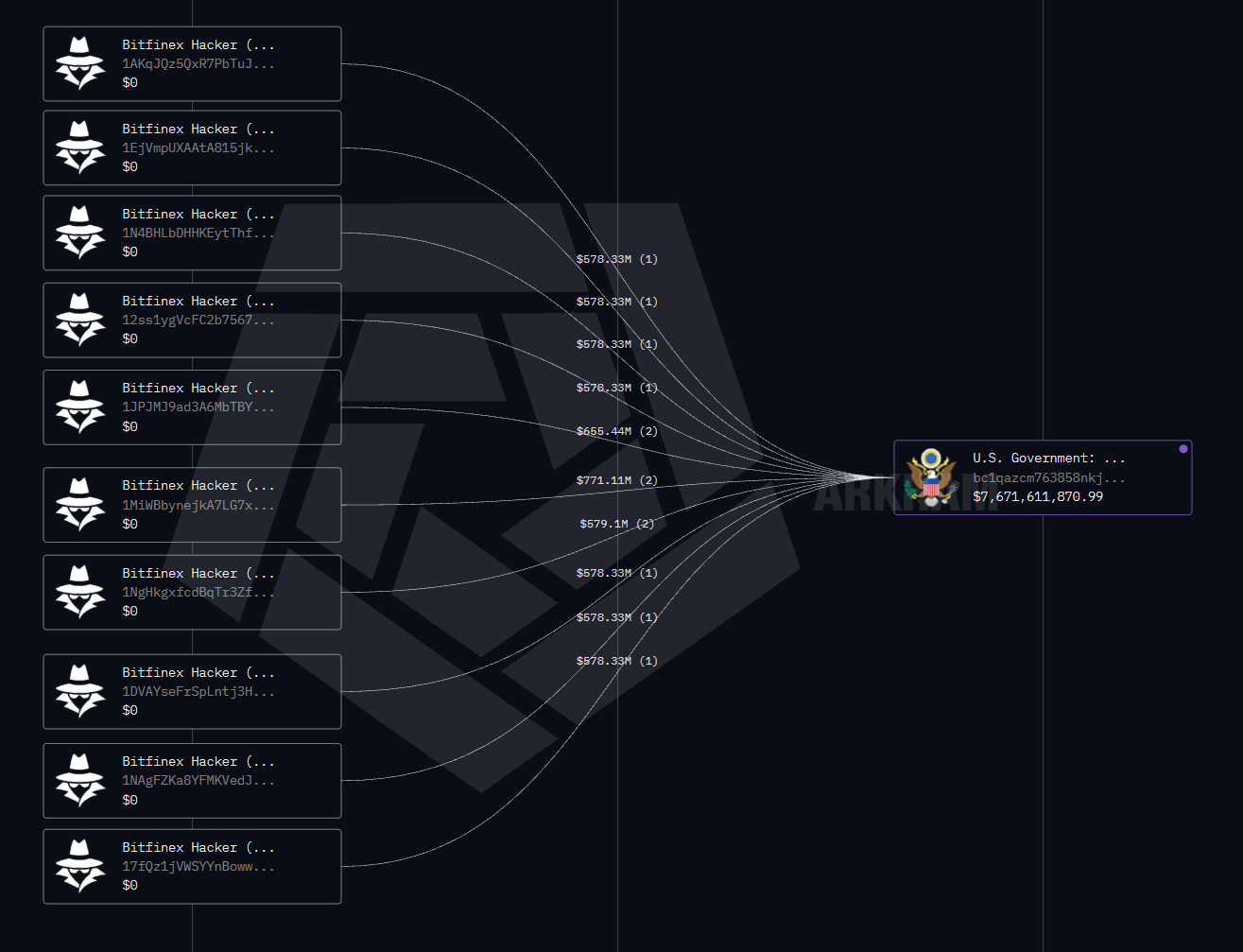
In August 2016, prominent cryptocurrency exchange Bitfinex was drained for 119,754 BTC into a single attacker wallet. The stolen funds remained untouched for a while, but began moving in January 2017 through AlphaBay, a now-defunct dark web marketplace. AlphaBay was used as a mixer, as the hacker wallet deposited stolen Bitcoin and withdrew it elsewhere in the platform to break the on-chain trail. The withdrawn Bitcoin was then passed through several exchanges, and then became quiet again. The case remained cold until February 2022, when federal agents obtained a warrant for an online account belonging to Ilya Lichtenstein and found a file containing private keys to the original attacker wallet. Agents arrested Ilya and his wife Heather Morgan, and were able to seize ~94K BTC in one go, which was worth $3.6 billion at the time of the seizure. Two smaller follow-up recoveries of 12,267 BTC and 1,155 BTC brought the total seized amount to just over 108,000 BTC. Lichtenstein confessed to hacking Bitfinex and pleaded guilty in August 2023 and his wife Morgan pleaded guilty to money laundering conspiracy and related charges, the couple was sentenced to five years and 18 months in prison respectively.

The most recent and by far largest addition to the US Government’s Bitcoin holdings occurred in October 2025 when the US Department of Justice unsealed an indictment against Prince Group’s Chen Zhi. The Prince Group conglomerate was a front for forced-labor scam compounds in Cambodia, where trafficked workers were forced to target victims across the world with investment fraud schemes. Prince Group would launder the money obtained from these activities through a range of otherwise legitimate businesses, including a Chinese Bitcoin mining pool called LuBian. Prosecutors also filed a civil forfeiture complaint for 127,271 BTC, worth ~$15 billion at the time, making it the largest single forfeiture in the Department of Justice’s history. These coins were traced back to a hack of LuBian’s holdings that was uncovered by Arkham sleuths, and sat untouched for years before investigators were able to tie the coins to Prince Group.
HAS THE US GOVERNMENT EVER SOLD BITCOIN?
The US Government has regularly sold Bitcoin over the last decade from its seizures.
The seized Bitcoin obtained from the Silk Road was auctioned off for the first time in June 2014, with venture capitalist Tim Draper acquiring around 30,000 BTC for $632 a coin for a total of $18.7 million.
A second auction of 50,000 BTC followed in December of that same year. This time Draper won a 2,000 BTC block. Other buyers included Coinbase and a syndicate led by SecondMarket's Bitcoin Investment Trust.
Two more auctions in 2015 cleared out the rest of the Silk Road coins: another 50,000 BTC in March, and a final 44,341 BTC in November. Across the four auctions, the US Marshals sold off roughly 174,000 BTC in total - coins that would be worth tens of billions of dollars today.
After the Silk Road auctions, US Government Bitcoin sales took a pause. 9,861 Bitcoin from the James Zhong seizure was sold in March 2023 for ~$216 million. Wallets tied to the US government moved Bitcoin from the James Zhong seizure to Coinbase Prime across 2024, while the "Individual X" stash of 69,370 BTC sat untouched in its government wallet. In January 2025, a federal court finally gave the Department of Justice approval to sell that entire stash. This sale never occurred however, when the Trump administration signed an executive order creating the Strategic Bitcoin Reserve. The order took the “Individual X” stash of Bitcoin off the market and added it to the new Strategic Bitcoin Reserve, cancelling what would’ve become the US Government’s largest Bitcoin sale of all time.
WHAT IS THE STRATEGIC RESERVE?
On March 6th, 2025 President Donald Trump signed an executive order establishing the Strategic Bitcoin Reserve as well as an accompanying U.S. Digital Asset Stockpile. The SBR is managed by a dedicated office within the Treasury Department and is capitalized completely with Bitcoin that the Treasury holds from seizures and civil forfeitures.
When the SBR was established, estimates of total holdings ranged from 198,000 to 207,000 BTC. Other federal agencies holding Bitcoin were asked to evaluate whether or not they had the legal authority to transfer their holdings to the SBR. All federal agencies were required to provide the Treasury with accounting statements of Bitcoin and any other digital assets they held, as no previous attempts have been made to properly keep track of all holdings across all agencies. The executive order also directed the Treasury and Commerce Secretaries to figure out “budget-neutral” strategies that would allow the SBR to acquire more Bitcoin without direct cost to taxpayers.
WILL THE GOVERNMENT SELL ITS BITCOIN?
Under current government policy, the US Government will not sell any of its Bitcoin. The idea behind the SBR is for the government to hold Bitcoin the same way it does gold and oil reserves. White House crypto advisor David Sacks has pointed out that roughly $17 billion in value was lost when the US Government sold its Bitcoin over the years at a fraction of current prices, and this framing is a strong reason why the US Government has shifted towards holding its Bitcoin. There also exists a legislative push for the US Government to begin actively buying Bitcoin with Senator Lummis’s BITCOIN Act, which would direct the Treasury to actively purchase up to 1 million Bitcoin over a five year span in a “budget-neutral” manner. However, as of mid-2026, the BITCOIN Act has not yet been passed and the US Government has not bought any Bitcoin through “budget-neutral” strategies.
WHAT OTHER CRYPTOCURRENCIES DOES THE US GOVERNMENT OWN?
When President Trump announced the Digital Asset Stockpile, Ethereum, XRP, Solana, and Cardano were named as assets that he wanted this stockpile to hold. However, when President Trump signed the Executive Order, the only meaningful non-Bitcoin digital asset the US Government held was 56,035 ETH, worth about $121 million.
In June 2026, The US Government held around 62K ETH. Around 46K ETH was transferred to Coinbase Prime during July 2026 and it is unclear whether this continues to be held by Coinbase on the government's behalf or if it was sold. The government still has 17.4K ETH in its Arkham entity.
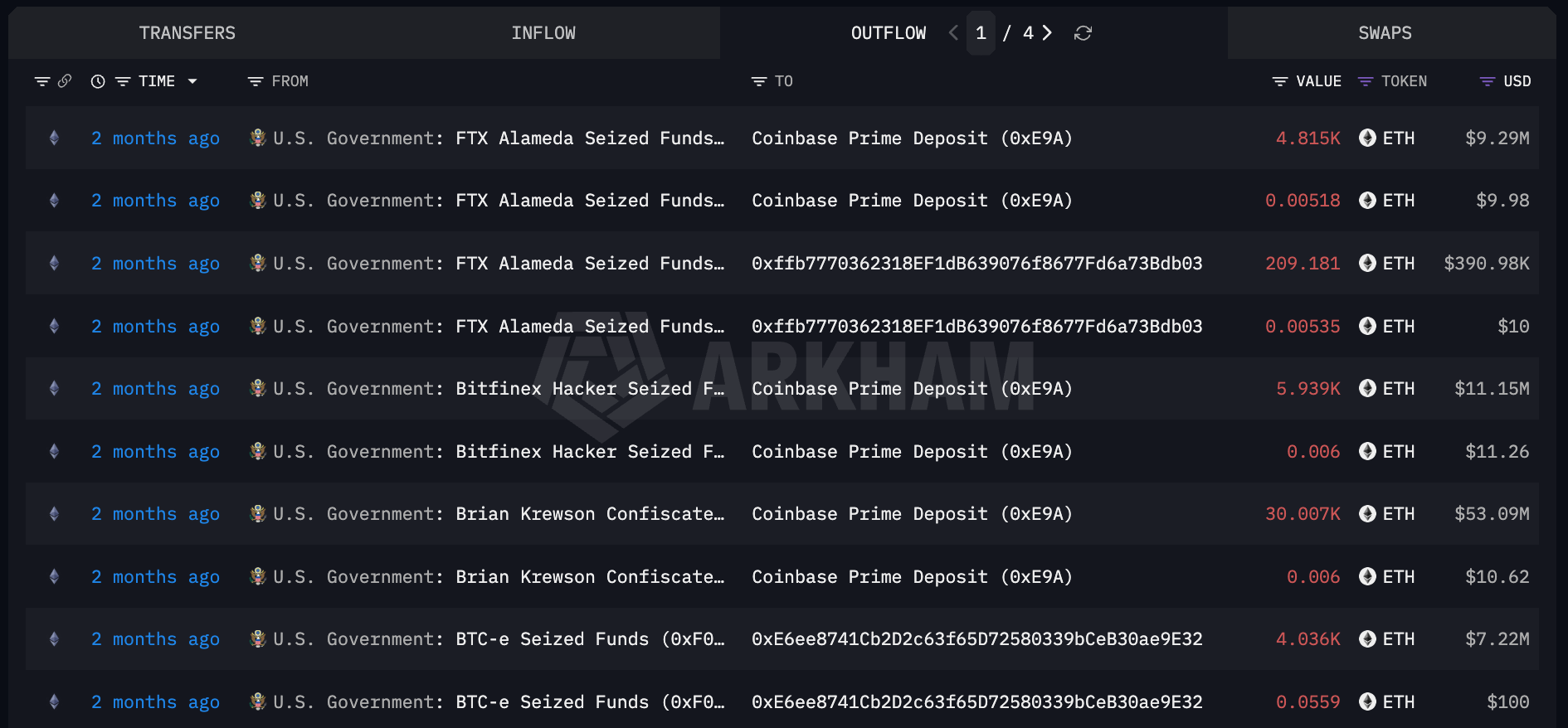
In addition to BTC and ETH, the US Government has $126 million in USDT, $63 million in WBTC, $31 million in BNB, as well as smaller holdings in various other cryptocurrencies.
It’s worth noting that unlike the SBR, the Digital Asset Stockpile does not have an acquisition mandate attached to it. The Digital Asset Stockpile will only grow when future seizures and forfeitures allow the US Government to acquire more of these non-Bitcoin assets.
CONCLUSION
The US Government has managed to build a sizable 325,000 Bitcoin position simply by cracking down on the dark web, recovering funds stolen in hacks, and prosecuting fraudsters. The US previously would sell the Bitcoin it acquired, but that is no longer the case. In the past, the US Government also made no active effort to invest in a Bitcoin position, but the existence of the Strategic Bitcoin Reserve now gives the US Treasury room to explore doing so. No active purchases have occurred in the eighteen months since President Trump signed the executive order establishing the Strategic Bitcoin Reserve, and any new additions to the US Government’s holdings have come from seizures and forfeitures. There has been some legislative push for the US Government to become an active buyer of Bitcoin, but no laws mandating it have been successfully passed.

.png)



.jpeg)






.png)











.png)

.jpg)







.png)
.png)




.png)


.png)

.png)
.png)

.png)
.png)









.png)
.png)
.png)
.png)



.png)